Gambling Affordability Checks: What They Are and What to Do
You are playing at your usual online casino when your account is suddenly restricted. A message appears asking for payslips, bank statements, or other personal financial documents. The request feels sudden and invasive, stopping you from depositing or, worse still, withdrawing your winnings. If you are currently locked out of your account, do not panic: this is not a scam, you have not done anything wrong, and your money is safe. What you are experiencing is one of the new UK gambling affordability checks (now officially termed financial risk checks). They are becoming a routine part of playing at UK-licensed online casinos. It is not the casino trying to steal your winnings or be difficult; rather, they are legally required by the UK Gambling Commission to verify you can afford your level of play once you hit certain spending thresholds. The BestCasinoSites.net team has created this guide to explain what these checks are, the exact financial limits that trigger them, and what to do when you are asked to complete one. Knowing the process is the fastest way to get your withdrawal approved and get back to playing. Produced by:
Editorial Team
Produced by:
Editorial Team
Published: 13 March 2026






What Are Gambling Affordability Checks (And How Are They Different from KYC)?
First, it is important not to confuse affordability checks with the ID verification you complete when you first join a casino. KYC (Know Your Customer) is the one-off identity and age check all players must pass before depositing. You provide ID (like a passport or driving licence) and proof of address to confirm your identity.
In contrast, an affordability check (now officially termed a financial risk check by the UK Gambling Commission) is an ongoing review. The casino has a responsibility to see that you are gambling within your means and not showing signs of financial harm. The check is about your financial situation, not just your identity. These reviews are triggered by your spending patterns and are a core part of a casino’s safer gambling and anti-money laundering obligations.
The Rules Behind Gambling Commission Affordability Checks
Casinos don’t conduct these checks by choice to annoy you; they do it because the UKGC legally requires them to. The framework for Gambling Commission affordability checks forces online casinos to step in if they spot risk indicators. The UKGC has issued multi-million-pound fines to casino sites that neglect these player protection obligations.
The first major requirement is preventing gambling harm. Because the UKGC’s central mission is to make gambling safer, its customer interaction guidance legally forces online casinos to step in if they spot risk indicators. Alongside affordability, casinos are also bound by strict Anti-Money Laundering (AML) rules. Casinos must conduct “Source of Funds” (SoF) checks under the Money Laundering Regulations 2017. SoF is designed to confirm that your money comes from a legitimate source, such as a salary. Because the same financial documents are often used to prove both affordability and legitimate funds, these document requests usually happen at the same time.
Looking ahead, the UK government’s recent gambling white paper has pushed the industry toward more “frictionless” checks. This signals that while casino affordability reviews will become more common across the board, the new technology used to conduct them will hopefully make the process much less disruptive for the average player.
Manual vs. Modern: How These Checks Work
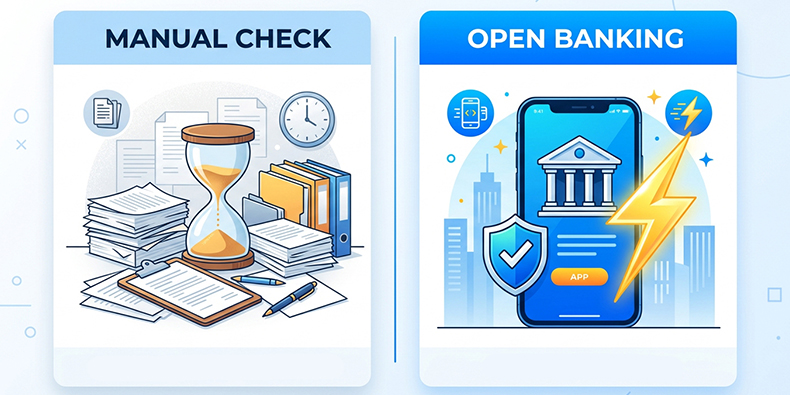
Historically, gambling affordability checks at UK online casinos were a clunky, manual process. Today, the system is split into three distinct methods, relying more heavily on technology to reduce friction for the player.
| Check Type | How It Works | What’s Required | Player Experience |
|---|---|---|---|
| Frictionless Checks (Background) | Triggered by low-level limits (e.g., £150 net deposit). The casino checks public records via Credit Reference Agencies (Equifax, Experian, TransUnion) for severe financial vulnerabilities like bankruptcies. | Nothing. It happens automatically. The casino never sees your bank account or raw financial data. | Invisible. Leaves a harmless “soft footprint” on your credit file that does not affect your credit score or future lending. |
| Open Banking (Optional) | Offered when you hit higher loss limits. You grant secure, temporary, read-only access to your bank data so an algorithm can quickly assess your disposable income. | Permission to connect to your bank via a trusted provider like Trustly or TrueLayer. | Fast (often instant) and secure. Saves you from having to download and email sensitive PDF documents. |
| Manual Checks | Triggered by higher net loss thresholds. A casino compliance team manually reviews your financial documents to ensure you can afford your gambling limits. | Digital copies of official bank statements, payslips, P60s, or tax returns. | Slow, invasive, and frustrating. Usually results in a temporary account restriction until resolved. |
The trend is clearly shifting towards frictionless checks. When an online casino runs a gambling affordability check on your credit file via agencies like Experian, Equifax, or TransUnion, they are only looking at your financial vulnerability (such as bankruptcies or unpaid debts), not your actual credit score. This type of review leaves a harmless “soft footprint” that future lenders cannot see.
What Triggers an Affordability Check?
Triggers vary between casino groups, and the exact thresholds can change over time. Some reviews are triggered automatically by your numbers, while others happen because your activity looks unusual for your account profile. The common thread is that the casino site sees something that suggests higher risk and wants to confirm you can afford gambling at your level of play.
- Hitting a Net Deposit Limit: This is the most frequent trigger for a low-level background check. As of February 2025, the UK Gambling Commission requires casinos to run a financial vulnerability check if your net deposits (your deposits minus withdrawals) hit £150 within a rolling 30-day period.
- Hitting a Net Loss Limit: Higher-level checks (the ones that usually require you to upload bank statements) are triggered by how much you lose, rather than just what you deposit. The government’s proposed limits for these deeper checks are a net loss of £1,000 within 24 hours (to catch “binge” gambling) or £2,000 within 90 days.
- Rapid Escalation of Deposits: Suddenly depositing much more, or more often, than your established pattern.
- Depositing and Withdrawing Large Amounts: This can flag money laundering concerns, which will initiate SoF and affordability checks.
- Using Multiple Payment Methods: Consistently depositing from several different cards or e-wallets.
- “Binge” Gambling: Logging very long sessions or playing at unusual hours is sometimes seen as a risk indicator, prompting a check.
None of these triggers automatically mean you have done anything wrong. They just tend to be the points where UK-licensed online casinos are expected to pause and take a closer look. In fact, a 2025 academic study analysing UK open banking data found that while these limits successfully flag at-risk individuals, about half of the players who trigger them are simply “diversified spenders” whose gambling is perfectly proportionate to their income. So, if you feel a check is unnecessary and invasive, the data often agrees with you but the casino is still legally required to run the numbers.
What to Do When Your Account is Flagged for a Check
Being asked for financial documents is unsettling and annoying, but your response is important. Don’t panic. This is a standard procedure. Your funds are safe, and a document request does not mean you have done anything wrong. The fastest way to restore your account is to respond promptly and provide what has been requested, as delaying will only prolong the restriction. When you are ready to submit your files, always upload documents securely through the casino’s encrypted portal rather than sending sensitive bank statements over standard email.
The biggest pain point for players is getting their documents repeatedly rejected by the casino. To ensure your submission is accepted the first time, you must submit the correct formats. Compliance teams require official PDFs downloaded directly from your bank, not cropped mobile phone screenshots. You must also ensure that your full name, home address, and account number are clearly visible and match your casino account details exactly. Furthermore, documents usually must be dated within the last 90 days. While you might be tempted to hide specific personal purchases, do not over-redact your statements. The compliance team needs to verify your proof of funds (like your salary or other income) and your gambling outgoings. Heavy redactions will result in an automatic rejection.
Finally, it is important to know your rights. You can always ask the casino why the affordability check is being conducted. You also have the right to refuse to provide the information, though be aware that this will likely result in your account being closed or permanently limited. If you disagree with the process or feel the casino is handling your data improperly, your first step should be to file a complaint directly with the casino. If that fails to resolve the issue, you can escalate your case to their assigned Alternative Dispute Resolution (ADR) service, such as IBAS.
The Flip Side: Why Some Players Seek Out Unlicensed Casino Sites These rules carry a real risk. Too much friction caused by affordability checks gambling sites force upon players can nudge some users toward unregulated, illegal “black market” sites that offer no protections at all. Research into this “dark side” of enforcement shows the difficult challenge regulators face: making the licensed market safe without pushing casino players towards the black market.
A concept currently being discussed is the “single customer view”, a centrally shared system that would let licensed sites see a player’s overall position across the market, rather than only what happens on one site. The basic idea is simple: if a player hits limits or triggers risk markers at Casino A, they should not be able to sidestep the restrictions by opening an account at Casino B and starting again from zero. In theory, it strengthens safer gambling because the casino is no longer working with partial information.
In practice, this starts to look a lot like the direction Germany has already taken with its LUGAS monitoring system. LUGAS gives regulators and online casinos a joined-up view of player activity across all licensed sites to enforce centralised deposit limits. While a UK-style single customer view would not necessarily copy the German model directly, our explainer on LUGAS and centralised limits shows exactly where this can lead: central monitoring, cross-casino controls and a much tighter definition of what counts as safe play.
The trade-off is around who controls the data and privacy. A shared view requires common identifiers, standardised data formats as well as rules that are clear around who can see what, when and for what purpose. While it has player protection at its heart, it highlights obvious questions about security and whether sensitive financial and behavioural data should be pooled across the entire industry. It may also have unintended consequences: the more centralised and restrictive the licensed market becomes, the more tempting unlicensed sites can look to people who want fewer checks and fewer questions. However, risking your money on the black market removes all your player protections. Sticking to licensed casino sites is the only way to guarantee your funds are safe and that any checks are conducted legally.
Conclusion: A Necessary Hurdle
When it comes to affordability checks, gambling in the UK is highly regulated, and online casinos have no choice. They can feel like an awkward interruption, but they are a non-negotiable part of the UK’s regulated market. The move towards technology-driven solutions is improving the experience, but the core requirement for online casinos to make sure their customers can afford to play will remain. Being prepared for these checks and knowing how to respond makes them a minor hurdle instead of a major roadblock.
Organisations like BeGambleAware, GamCare, and the national self-exclusion scheme GamStop offer free, confidential support if gambling is causing problems in your life. All our recommended online casino sites provide in-account controls including deposit limits, loss limits, time-out periods, and self-exclusion. If you are concerned that gambling is affecting your finances, personal life, or someone you know, these organisations offer crucial assistance.
Frequently Asked Questions
These are some of the most commonly asked questions and answers about the affordability issues at UK casino sites.