Apple Pay and Google Pay at UK Casinos - How to Deposit Without Sharing Card Details
Not so long ago, funding an online casino account was a uniquely cumbersome process. You had to dig out your physical wallet, type in a 16-digit debit card number, double-check an expiry date, input a CVV code, and then wait for a 3D Secure text message to arrive from your bank. It worked, but it never felt like an experience built for the modern digital era. For the vast majority of UK players today, that same deposit requires nothing more than a glance at a screen or the tap of a fingerprint. Apple Pay casinos in the UK and Google Pay casinos have grown rapidly in number, and the reasons are straightforward: speed, simplicity, and the fact that your actual card details never reach the operator. While the process feels frictionless, misconceptions persist. These digital wallets do not alter the strict regulatory framework of UK gambling. They do not bypass mandatory affordability checks, they cannot circumvent bank-imposed gambling blocks, and they offer no anonymity whatsoever. The team at BestCasinoSites.net has put this page together to explain what making an Apple Pay casino deposit or using Google Pay casino deposits actually changes for you as a player, where the technological and practical limits lie, and whether the security benefits are as significant as they appear. Produced by:
Editorial Team
Produced by:
Editorial Team
Published: 7 April 2026






The Evolution of Casino Payments
To understand why Apple Pay and Google Pay have made such a significant impact, you need to look at the shift in player habits. Over the last decade, the UK gambling sector has transitioned from a desktop-first industry to a mobile-dominated one. Today, the majority of deposits and bets at UK operators happen on smartphones.
Traditional card deposits were designed for physical terminals and desktop keyboards. On a mobile device, typing long strings of numbers is error-prone and frustrating. E-wallets like PayPal and Skrill offered a solution, but they required you to create secondary accounts, remember additional passwords, and shuffle money between various digital pots.
Apple Pay and Google Pay represent the next step: the pass-through digital wallet. They do not hold your money. Instead, they act as a highly secure, frictionless bridge between your existing bank account and the casino.
How Apple Pay and Google Pay Function Technologically
At the core of both Apple Pay and Google Pay is a technology called tokenisation. When you add your debit card to your iPhone or Android device, the wallet does not store your actual card number. Instead, it contacts your issuing bank, which generates a unique Device Account Number, or token. Your device encrypts this token and stores it securely in a dedicated chip known as the Secure Element.
Whether you are making an Apple Pay casino deposit or processing one of many Google Pay casino deposits each week, the underlying mechanism is the same. The process relies on this token rather than your card details.
- Initiation: You select your deposit amount and tap the Apple Pay or Google Pay button.
- Authentication: Your device prompts you for biometric verification, typically Face ID, Touch ID, or a device passcode.
- Transaction: The device sends the encrypted token, along with a dynamic, transaction-specific security code, to the casino’s payment gateway.
- Completion: The payment processor decrypts the token, verifies it with your bank, and the funds appear in your casino account almost instantly.
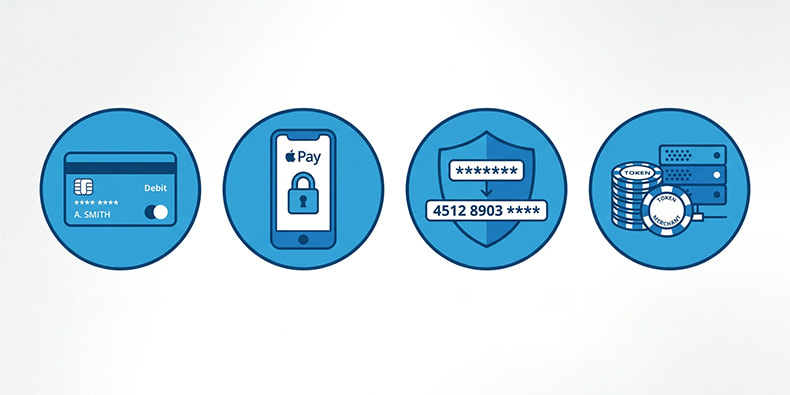 Because the casino only ever receives a single-use cryptogram and a token, your actual debit card details are never exposed to or stored on the operator’s servers.
Navigating the UK Regulatory Environment
For casinos operating under the strict oversight of the UK Gambling Commission (UKGC), biometric digital wallets fit seamlessly into the current regulatory framework.
Crucially, in April 2020, the UKGC introduced a blanket ban on credit cards for gambling. This applies to digital wallets too. If you have a credit card linked to your Apple Pay or Google Pay wallet and attempt to use it at a UK-licensed casino, the payment processor will automatically block the transaction. Only linked debit cards are accepted. This rule holds whether you are browsing Apple Pay casinos in the UK or funding your account at Google Pay online casinos.
Digital wallets do not mask your identity from the casino or your bank either. Strict identity verification protocols and anti-fraud measures remain fully in effect. When you deposit via Apple Pay, the name on your linked bank account must match the name registered to your casino account. These payment methods also cannot bypass affordability checks. Transactions appear clearly on your bank statements as gambling expenditure, allowing both your bank and the casino to monitor spending exactly as they would with a physical debit card.
For a closer look at specific sites that accept this method, visit our Apple Pay casinos page.
Why UK Casinos Are Eagerly Adopting Digital Wallets
Integrating Apple Pay and Google Pay solves a major compliance headache for casino operators.
Under the EU’s PSD2 directive, which the UK Financial Conduct Authority continues to enforce, online transactions require Strong Customer Authentication (SCA). SCA demands that you verify a payment using two independent elements from categories such as possession, knowledge, or inherence.
Before biometric wallets, SCA meant banks sending SMS codes that players had to type into the casino cashier. It was a clunky process that led to a high rate of abandoned deposits, with players simply giving up and closing the app.
Apple Pay and Google Pay satisfy SCA requirements instantly. Because you use your physical device alongside facial or fingerprint recognition, the system meets the strict regulatory standard in under a second. For operators, this is a compelling reason to list themselves among the growing number of Google Pay online casinos and Apple Pay-friendly sites. Fewer abandoned deposits, less friction, and a smoother experience for everyone involved.
What Players Gain, and the Practical Limitations
The advantages of using digital wallets for casino deposits are considerable, but you should also be aware of the functional constraints.
The Upsides
- Data Privacy from Merchants: The casino never sees or stores your 16-digit card number. All it receives is a tokenised reference.
- Unmatched Speed: Whether it is an Apple Pay casino deposit or one of many Google Pay casino deposits you make over a session, biometric confirmation is the fastest method currently available in the UK online casino space.
- Built-in Device Security: Even if someone gains access to your unlocked phone, they still cannot authorise a deposit without your specific biometric signature or financial passcode.
- Zero Account Creation: Unlike Skrill, Neteller, or PayPal, you do not need to set up a separate third-party account. The wallet is already built into your smartphone’s operating system.
The Limitations
- Withdrawal Complications: This is the most significant drawback. Apple Pay and Google Pay use one-way transaction frameworks designed to push money securely out of your account. Reversing that process to return winnings to the wallet is highly complex. In the vast majority of cases, UK casinos cannot process withdrawals back to Apple Pay or Google Pay. You will typically need to request a withdrawal via standard bank transfer or provide your underlying debit card details to receive your funds.
- No Anonymity: If you want to keep gambling transactions off your main bank statement, these wallets will not help. The charge passes directly to your underlying bank account.
- Gambling Blocks Still Apply: Many UK banks offer optional gambling blocks on debit cards that you can activate to prevent betting transactions. Using Apple Pay or Google Pay will not bypass these blocks. Your bank recognises the Merchant Category Code for gambling and will decline the tokenised request just as it would any other.
How Apple Pay and Google Pay Compare to Other Casino Payment Methods
Digital wallets now share the cashier screen with other modern payment options like PayPal and Open Banking. Here is how they stack up against the alternatives. PayPal acts as a true e-wallet. It holds a balance and creates a buffer between your bank and the casino. It handles both deposits and fast withdrawals effectively, but the deposit process requires you to log into the PayPal interface, which is slower than a biometric tap.
Open Banking links directly to your bank account via an API. It is extremely secure and supports instant withdrawals. However, depositing often requires you to log into your banking app to approve the transaction, adding an extra step.
Google Pay casinos and Apple Pay casinos in the UK sit in the middle ground. They are faster than Open Banking for deposits and simpler than PayPal, but they lack the seamless withdrawal capabilities of both.
To see which sites currently accept this method, visit our Google Pay casinos page.
| Payment Method | Deposit Speed | Withdrawal Speed | Card Details Shared | Biometric Required | Separate Account Needed? |
|---|---|---|---|---|---|
| Apple Pay | Instant | Not Supported / Bank Transfer | No (Tokenised) | Yes | No |
| Google Pay | Instant | Not Supported / Bank Transfer | No (Tokenised) | Yes | No |
| PayPal | Instant | Instant to 24 Hours | No | Optional | Yes |
| Open Banking | Instant | Instant | No | Yes (Banking App) | No |
| Manual Debit Card | Instant | 1–3 Business Days | Yes | No | No |
Security: Is It Actually Safer? It is easy to assume that a faster process might be a less secure one. With Apple Pay and Google Pay, the opposite is true.
Regulated UK casinos already operate under strict PCI-DSS compliance, meaning stored card details are heavily encrypted. However, cyber security is an arms race, and data breaches do occasionally occur across the broader e-commerce landscape.
Tokenisation makes the threat of a casino data breach largely irrelevant to your personal finances. If a cyber attack were to compromise a casino’s servers, the only payment data exposed would be meaningless, single-use tokens. Without the physical Secure Element inside your specific smartphone, those tokens cannot be reverse-engineered into a workable debit card number.
In practical terms, this is one of the strongest reasons to consider Google Pay casino deposits or an Apple Pay casino deposit over manually entering your card details. These wallets reinforce an already strong system by removing the risk of operators storing your actual financial data entirely.
Where the Industry Is Heading
Biometric verification is rapidly becoming the standard across all forms of global e-commerce, and the UK gambling sector is simply following the wider consumer trend. As mobile-first gameplay continues to dominate, the act of manually entering card details on a small touchscreen will soon feel like an outdated practice. The next frontier for Google Pay online casinos and Apple Pay casinos in the UK is solving the withdrawal problem. Payment providers are actively developing closed-loop tokenised withdrawal systems that will eventually allow casinos to push winnings back to your mobile wallet as seamlessly as they accept deposits. Until that technology matures, wallet-based deposits will continue to reduce friction, satisfy rigorous FCA authentication requirements, and align perfectly with how people already pay for their groceries, train tickets, and morning coffee.