UK Gambling Commission Deposit Limits Explained - Casino Deposit Rules for 2026
You try to deposit £500. The casino stops you at £250. You don't remember setting a limit, so why is there one? Understanding Gambling Commission deposit limits and online casino deposit rules helps you play confidently. Deposit limits at casinos licensed in the UK have moved well beyond being a budgeting option buried in account settings. They are embedded into how accounts function from the start, and increasingly tied to obligations imposed by the UK regulator. Knowing what they actually do, and why they sometimes shift without warning, is now essential for anyone playing at a UK-licensed site. This BestCasinoSites.net guide covers what deposit limits actually control, when casinos can refuse increases, how they interact with affordability checks and what has changed since the UK's recent gambling reforms. Produced by:
Editorial Team
Produced by:
Editorial Team
Published: 31 March 2026






What is a Deposit Limit?
A UK Gambling Commission deposit limit is a strict cap on the total funds you can add to your casino account across a set period – daily, weekly, or monthly. Under the UKGC’s updated Remote Technical Standards (RTS 12B), these must operate as Gross Deposit Limits. This means the cap applies strictly to the money you put in, regardless of any winnings you withdraw during that same timeframe. It does not automatically limit losses, wagering volume or session time. Conflating these is one of the most common misunderstandings players have about how their account protections actually work.
Under UK licensing conditions, online casinos must make it easy for players to set spending caps. Reductions apply immediately. Increases are subject to a delay period, a deliberate cooling-off window built to stop impulsive decisions from overriding a previous choice. The UKGC’s licence conditions and codes of practice set out the baseline requirements sites must meet.
Voluntary limits versus casino-applied restrictions
Players come across two quite different types of deposit control and confusing the two causes a lot of unnecessary frustration.
Voluntary limits are set by the player and cover the amount you can deposit across a chosen timeframe. Under the UK’s recent gambling reforms, the visibility of these limits changed fundamentally. Following rules that came into force in late 2025, all UK-licensed casinos are now required to explicitly prompt customers to set a financial limit before they make their first deposit.
“Prompting” means the casino must interrupt your journey and force you to make an active choice before you can fund your account; they can no longer leave the tool buried in your account settings. While the UKGC requires the casino to ask the question, it does not legally force you, the player, to set a numerical limit. You can usually select an option like “No Limit” or “Opt-Out” to proceed. However, you cannot avoid the prompt itself.
Once your account is active, you can adjust these limits inside the cashier section at any time. Reductions take effect instantly. Increases only activate after a mandatory cooling-off period (usually 24 hours) though some operators extend this to 72 hours depending on the size of the increase requested.
Casino-applied restrictions work differently. These may follow internal compliance reviews, affordability triggers or spending threshold alerts. The casino may lower your permitted deposit amount or pause deposits entirely pending a review. These restrictions have a clear regulatory basis and are not applied at random. They exist because licensed sites are required to monitor affordability and flag financial risk before it escalates. Knowing which type you are dealing with matters because the route to resolving each one is completely different.
How deposit limits work day to day
If you set a £500 weekly deposit limit and reach that amount by Wednesday, the system will block further deposits until the weekly cycle resets. The UKGC clarifies that these reset periods must be clearly defined (e.g., Monday to Sunday) rather than using confusing “rolling” timeframes. Furthermore, if you have multiple limits active (such as a £50 daily limit alongside a £500 weekly limit) the system is hardwired so that the most restrictive limit always prevails.
Gambling Commission deposit limits apply at account level across all payment methods. You cannot bypass it by switching your payment method. Even if you choose an operator from our lists of direct bank transfer sites or Apple Pay supported casinos, the overall account cap remains exactly the same. Customer support cannot override it.
Most casino sites display a tracker in the cashier section showing how much of your current allowance remains before the next reset. If yours does not, that is worth noting when you are weighing up how transparent the casino brand actually is.
What the recent and upcoming reforms changed
Following the UK government’s gambling white paper and the subsequent UKGC consultations, expectations around affordability monitoring were significantly strengthened. Casino sites are now required to monitor cumulative net deposits, identify accelerated spending behaviour, carry out vulnerability checks with reduced friction and step in earlier where risk markers appear.
Alongside affordability monitoring, the UKGC has overhauled how limits are designed and labelled, with final implementation required by June 2026. Casinos can no longer use confusing or interchangeable terminology. A “spend limit” must now be accurately labelled a stake limit, and a loss limit must strictly reflect total stakes minus returns. If a casino wishes to offer a limit that factors in your withdrawals, it must explicitly be called a “Net Deposit Limit” and offered only as an optional extra alongside the mandatory gross deposit limit.
The UKGC’s published guidance on affordability checks explains how frictionless checks work at lower thresholds and when enhanced checks requiring documents are expected to kick in. Deposit limits now sit inside a wider compliance framework rather than functioning purely as player-controlled budgeting tools. In practice, a limit that changes unexpectedly is often the result of automated monitoring reaching a threshold, not a manual decision by a support agent.
For a fuller explanation of how affordability checks work in practice and what casinos are actually looking for, see our article on UK gambling affordability checks.
Gambling Deposit Limits vs Other Casino Tools
When looking at casino deposit limits in the UK, it is important to remember that a deposit limit caps how much you can add to your account in a session or cycle. It does not stop you losing that entire amount within minutes of depositing. That gap between what you can put in and what you can lose is not a technicality, and it catches players off guard more than most other account controls do.
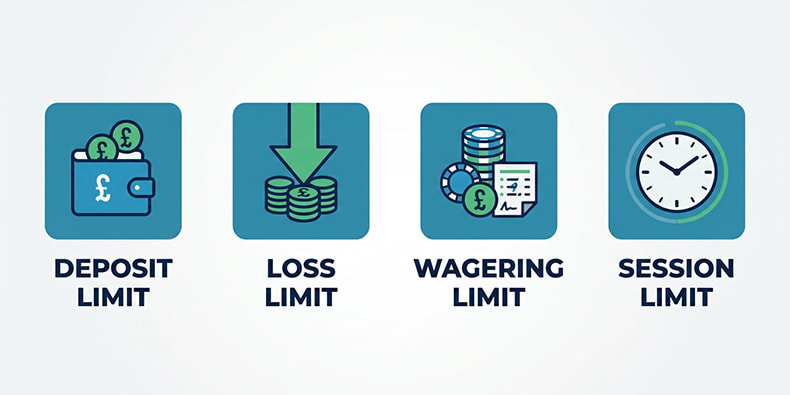
Each of the major safer gambling tools serves a unique, specific role in how you manage your money and time, and regulators are actively enforcing strict definitions for UKGC deposit limits and other controls. A deposit limit controls the gross money added to your account. A loss limit strictly caps your total stakes minus your returns (winnings). A stake limit (formerly referred to as a spend or wagering limit) controls the total value of bets placed, regardless of whether those bets win or lose. Finally, a session limit controls the time you spend logged in. Setting one does not replicate the protection offered by another, and knowing the difference is worth the few minutes it takes. GambleAware’s safer gambling tools and advice covers this clearly.
Can a casino refuse to increase Gambling Commission deposit limits?
Yes, and this happens more often than players expect.
If you request a higher limit, the online casino may apply a mandatory activation delay, ask for supporting documents or decline the increase outright. This tends to happen when recent deposit activity has crossed internal affordability review thresholds. It can be frustrating when you are on the receiving end, but it reflects compliance obligations rather than a discretionary call by a customer service team. The casino is not making a personal judgement about you. They are responding to signals generated by your account activity.
If an increase is refused and you think it is unwarranted, the right approach is to contact the casino’s safer gambling team directly and voluntarily provide supporting financial documents. If the matter remains unresolved, you can take it through the casino’s formal complaints process. While you can attempt to contact an Alternative Dispute Resolution (ADR) provider, be aware that they are highly unlikely to intervene. ADRs exist primarily to resolve contractual betting disputes (such as unpaid winnings or voided bets), and generally do not have the jurisdiction to overrule an operator’s internal compliance or affordability decisions.
Deposit limits and affordability checks
If your deposits rise sharply over a short period, the casino may initiate a source of funds or affordability review. You may be asked to provide payslips, bank statements or proof of savings. Temporary deposit caps are commonly put in place during this period while the review runs its course.
What often surprises players is that the cap is frequently a symptom rather than the problem in itself. The compliance review triggered by higher spending is what produces the restrictions or delays. Regulators are focused on whether play is sustainable in the long run, not just the size of a single deposit. Having documents ready if you are a higher-spending player can take a lot of the friction out of these reviews when they arise.
Are limits shared across all UK casinos?
No. Deposit limits are applied per casino brand. The UK does not run a centralised cross-casino deposit cap system, so a £500 weekly limit at one site has no bearing on what you can deposit elsewhere. Each licensed operator monitors activity on its own site and may intervene independently. There is no national database imposing a single industry-wide monthly cap, and while this has been discussed at a policy level, nothing of that kind is currently in force.
The concept of a ‘single customer view'(where data is pooled across operators) recently became a reality in the UK with the launch of GamProtect in 2024. However, GamProtect is designed to share severe health and financial risk markers, not everyday deposit limits. Therefore, a £500 weekly limit at one site still has no bearing on what you can deposit elsewhere. The UK does not currently have a system like Germany’s LUGAS cross-casino monitoring system, which enforces a strict €1,000 monthly deposit cap across all licensed sites simultaneously.
Choosing casino sites with transparent limit policies
How openly casinos communicate deposit controls varies considerably. Before registering, it is worth going through the responsible gambling and safer play sections carefully, specifically how cooling-off periods are explained, how affordability checks are communicated and what actually triggers an operator-applied restriction.
At BestCasinoSites.net we assess UK-licensed casinos on the clarity of their deposit limit tools, the visibility of reset cycles and how openly they explain their affordability processes. Our recommended online casinos is a good starting point if you are looking for licensed sites that take responsible gambling seriously.
Online casino deposit limits in the UK are structured financial controls driven by reform and consumer protection policy. They are not arbitrary caps and they are not payment errors. These days they form part of a wider system that monitors affordability, deposit velocity and financial risk across the full history of an account.
When a limit activates unexpectedly, or when an increase is refused, it almost always reflects compliance monitoring rather than a technical fault. Understanding that framework makes the whole experience considerably less confusing and puts you in a better position to choose casinos who are upfront about how these controls work, rather than leaving players to find out the hard way.
Frequently Asked Questions
These are some of the most commonly asked questions and answers about UK online casino deposit limits.