Playing at Offshore Online Casinos from Pakistan - Risks in 2026
When evaluating online casinos in Pakistan, understanding the severe legal and financial risks is essential. While online gambling in Pakistan is broadly prohibited under the Prevention of Gambling Act 1977, offshore online casinos remain accessible and are actively used by a portion of the population. However, with intensifying government crackdowns, players face unique challenges. This article provides a comprehensive overview of the legal landscape, payment friction, data privacy, and what limited recourse exists if things go wrong - equipping you with the facts to understand exactly how these offshore markets operate. In 2025, enforcement activity intensified significantly. Pakistan's National Cyber Crime Investigation Agency (NCCIA) declared 46 gambling and trading apps illegal, including globally recognised names, and action against promoters escalated sharply. This BestCasinoSites.net article examines what that means for players today. Produced by:
Editorial Team
Produced by:
Editorial Team
Published: 27 March 2026






Is Online Gambling Legal in Pakistan in 2026?
The legislation that governs gambling in Pakistan is the Prevention of Gambling Act 1977. The Act prohibits gambling in all forms, carries penalties for those running platforms as well as those participating, and predates the internet by two decades. It has never been substantially updated to cover online activity. For anyone researching is online gambling legal in Pakistan, 2025 law enforcement actions alongside the 1977 Act provide a clear answer: it is not, and the state is actively cracking down on digital access.
The Act does make limited exceptions covering horse racing and a national lottery, but these do not cover online platforms of any kind. Historically, enforcement against individual online players has been limited and inconsistently applied. That changed materially in 2025.
Gambling Punishment in Pakistan Under the 1977 Act
The gambling punishment in Pakistan is explicitly laid out in the 1977 legislation. Under the Act, operating a gambling establishment carries fines of up to 1,000 rupees or up to one year’s imprisonment, or both. Participating in gambling at a common gaming house carries fines of up to 5,000 rupees or up to one year’s imprisonment, while public gambling can result in fines of up to 500 rupees or jail time.
What changed in 2025
In August 2025, the NCCIA declared 46 mobile applications illegal and instructed the Pakistan Telecommunication Authority (PTA) to block them nationwide. The list included major international platforms: Bet365, 1xBet, Betway, Casumo, Dafabet, 22Bet, Melbet, Parimatch, 10Cric, Rabona, BetWinner, 888Starz and Thunderpick among others.
Separately, Pakistani authorities arrested prominent YouTuber Saad ur Rehman, known as Ducky Bhai with around 9 million subscribers, at Lahore airport in August 2025. The charges related to promoting unregistered gambling apps including Binomo, 1xBet and Bet365. Officials indicated that further investigations into social media promoters were underway.
The Pakistan Cricket Board also prohibited direct gambling sponsorship in 2024 following a Peshawar High Court petition, and Wasim Akram faced public criticism for appearing in advertising for an Indian betting application.
The direction of travel is clear. Enforcement is escalating, not retreating. The 2025 crackdowns represent a clear departure from the years of limited action that preceded them, and players should factor this into any assessment of their own exposure.
Understanding Unlicensed Casinos in Pakistan
The term “unlicensed casino” gets used loosely in the Pakistani market and needs to be examined more carefully. Most offshore online casinos accessible from Pakistan do hold licences, but those licences are issued by foreign regulators. The most common include The Curaçao Gaming Authority, Malta Gaming Authority (MGA), a stricter EU-aligned regulator; the Gibraltar Regulatory Authority; and the Isle of Man Gambling Supervision Commission.
None of these licences give Pakistani players local consumer protections. A casino licensed in Malta operates under Maltese law. If a dispute arises, any recourse runs through Maltese or international complaint channels, not any Pakistani authority.
A casino with no licence at all sits in a much higher risk bracket altogether. Genuinely unlicensed casinos have no regulatory accountability to anyone. The risk of non-payment, fraud and misappropriation of personal data is substantially higher than at a poorly regulated but still licensed offshore online casino. For background on how offshore sites compare in terms of licensing quality and withdrawal track records, our list of the best online casinos in Pakistan covers what is currently available to players in the region.
Payment Risks and Financial Friction
Payment processing is often the first practical barrier Pakistani players run into. Local banks typically block gambling-related card transactions. The State Bank of Pakistan has long restricted gambling payments through formal banking channels, and international card networks including Visa and Mastercard may also decline payments depending on the merchant category code used by the casino.
As a result, most offshore online casinos actively promote cryptocurrency deposits to the Pakistani market. Digital currencies like Bitcoin and Tether are heavily marketed by these platforms as an alternative to traditional banking, though this brings severe complications.
The tradeoffs of these crypto deposits are significant. Transactions are entirely irreversible with no equivalent of a card chargeback, meaning no consumer dispute mechanism exists if funds are sent incorrectly or an account is locked. Furthermore, price volatility means the amount withdrawn could be worth considerably less than the initial win. Finally, full responsibility for wallet access sits with the individual, offering no safety net if log-in details or access keys are lost.
The regulatory position on crypto in Pakistan has shifted. The State Bank previously declared cryptocurrency illegal but the Virtual Assets Bill passed the National Assembly in March 2026, bringing cryptocurrencies under a formal regulatory structure and introducing a Digital Rupee. Players using crypto for casino deposits are therefore still dealing with two overlapping areas of uncertainty: gambling law and an evolving crypto regulatory framework that is now active but whose practical application to gambling transactions remains untested.
Dispute Resolution and Consumer Protection
This is where the practical gap between a domestically regulated market and Pakistan’s offshore landscape is most obvious.
In regulated markets like the UK, players have structured complaint routes through casino internal processes, then independent Alternative Dispute Resolution providers and ultimately a national regulator with real enforcement powers.
Pakistani players using offshore platforms have none of this infrastructure. If a dispute arises involving a refused withdrawal, a confiscated bonus or a locked account, the realistic routes are:
- The casino’s internal complaint process, where the site reviews its own conduct.
- A complaint to the foreign licensing authority, which tends to be slow, jurisdictionally awkward and offers limited practical reach over disputes involving Pakistani players.
- Third-party player advocacy portals. While watchdog sites cannot legally compel an offshore casino to pay out, they have a track record of generating enough public reputational pressure to force Curaçao-licensed operators to resolve delayed withdrawals or unfair account closures.
There is no Pakistani ombudsman, no local regulatory escalation route and no domestic legal recourse specific to gambling disputes. Licence quality matters enormously here, though the reality of the market significantly limits player choice. While an MGA-licensed casino faces much more rigorous complaint obligations than one licensed in Curaçao, MGA regulations strictly prohibit operators from accepting players from jurisdictions where gambling is illegal. Consequently, almost all reputable MGA casinos actively block registrations from Pakistan.
This leaves Pakistani players navigating an offshore market dominated almost entirely by Curaçao-licensed platforms. Because Curaçao oversight has historically been considerably lighter and relies heavily on the casino’s own internal fairness, players cannot rely on the regulator to save them if a dispute arises. This is the strongest practical argument for thoroughly researching a site’s specific withdrawal track record and reputation before depositing.
Account verification and withdrawal holds
A common misconception is that offshore online casinos operate with minimal compliance requirements. In practice, the majority of licensed international online casinos conduct anti-money laundering checks and customer identity verification that are broadly similar to those seen in regulated domestic markets.
Before processing a withdrawal, casinos usually require government-issued photo ID, a document confirming your address and confirmation of the payment method used. Where this tends to go wrong for Pakistani players specifically is when country access terms are revised after registration, potentially leaving funds in an account that can no longer be reached. Also, large wins may trigger enhanced source-of-funds reviews, especially at casinos running stricter compliance programmes. Furthermore, the NCCIA’s 2025 blocking orders mean certain casinos may become technically unreachable partway through a withdrawal process.
Because no Pakistani regulator oversees these platforms on behalf of local players, a frozen account has no domestic escalation path. Resolution depends entirely on the casino site and the body that issued their licence.
Data Protection and Privacy
Offshore casinos collect substantial personal information through account registration and KYC checks: passport scans, proof of address, payment details and in some cases full bank statement history. They operate under the privacy rules of their licensing jurisdictions, not Pakistani law.
Pakistan’s domestic data protection legislation has been in development for a number of years but had not been fully enacted by early-2026, and its provisions do not generally reach overseas gambling sites. Players are therefore reliant on whatever oversight the foreign regulator provides and the site’s own internal policies.
The NCCIA’s August 2025 crackdown flagged data harvesting as a concern that went beyond gambling alone. Several of the banned apps were found to be collecting SIM card and CNIC national ID information without any meaningful disclosure to users, which the agency described as a direct threat to personal security.
Before registering at any offshore casino, read the privacy policy carefully. Look specifically at where personal information is held, who it may be passed to and which country’s privacy laws would govern any complaint about how it was handled.
ISP restrictions and access stability
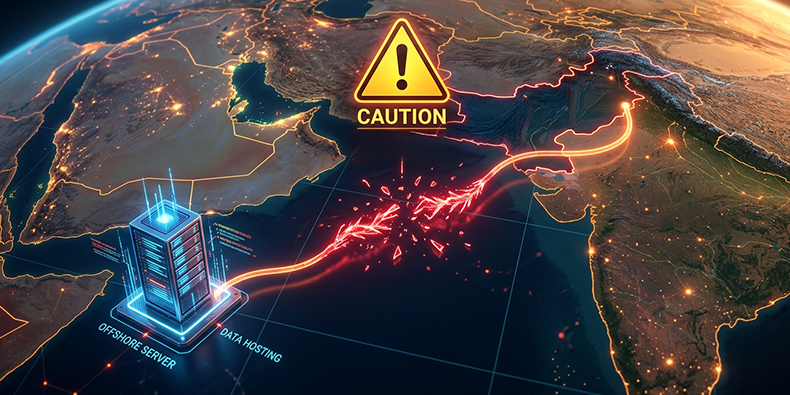
One risk that receives less attention is straightforward access stability: the possibility that a platform where you hold funds simply becomes unreachable. The PTA has broad powers to block websites and apps, and the 2025 NCCIA list demonstrated that even major international brands are not protected from this. Bet365 and 1xBet, two of the most widely used betting platforms across Asia, were both included and blocked without advance warning to users.
For players with active accounts or pending withdrawals, a sudden block creates a serious practical problem. Logging in to request a withdrawal, complete identity checks or contact support through the platform may become impossible at short notice.
Players should bear in mind that any accessible platform today can be blocked by the PTA without warning, that using methods to get round PTA blocks raises its own questions from both a legal standpoint and a personal security one, and that casinos may also choose to restrict Pakistani players voluntarily based on internal compliance decisions, entirely separate from any PTA action.
Risk Assessment Summary
| Risk Factor | Level | What It Means |
|---|---|---|
| Legal risk | Ambiguous | No explicit prosecution of individual online players widely reported, but gambling is broadly prohibited under the Prevention of Gambling Act 1977. Enforcement is escalating. |
| Platform access risk | High | NCCIA blocked 46 named platforms in August 2025. Bet365, 1xBet, Casumo and others are on the list. Blocks can be imposed without notice. |
| Payment friction | High | Local banks block gambling transactions. Crypto alternatives are heavily marketed but carry irreversibility and volatility risks. |
| Consumer protection | High | No domestic regulator. Dispute resolution depends entirely on the foreign licensing authority, third-party mediators, and the casino’s internal processes. |
| Data privacy | Moderate | Offshore casino sites are governed by foreign privacy rules. Pakistani domestic enforcement does not reach them. |
| Account and withdrawal risk | Moderate | Identity and AML checks apply at most licensed international casinos. Accounts can be frozen with no local regulator to escalate to. |
| Regulatory stability | Moderate | Enforcement is tightening. The 2025 crackdowns and Ducky Bhai arrest signal continued government attention on the sector. |
“Ambiguous” legal risk does not mean no risk. It means the legal position is not fully settled for individual online players in terms of mass prosecution. However, the direction of enforcement has been heavily toward greater restriction, not relaxation.
Understanding Risk Mitigation at Offshore Casinos
Because gambling is prohibited in Pakistan, this site does not advise or encourage readers to circumvent the law. For players in Pakistan who still choose to access offshore platforms despite the restricted legal environment and escalating enforcement, managing exposure is entirely about understanding operational risks. Because you cannot rely on a domestic regulator to step in if things go wrong, players who proceed typically take the following informational precautions:
- Frequent withdrawals rather than storing funds: Because the PTA can block access to specific casino domains without warning, treating a betting account like a savings account carries a high risk of funds becoming trapped. Players often withdraw winnings regularly in case a site suddenly becomes inaccessible.
- Navigating payment friction: Direct bank transfers and credit card payments are highly likely to be blocked by local banks. While casinos often promote stablecoins (like Tether) as an alternative to manage this friction, these methods operate entirely outside the formal banking protections of the State Bank of Pakistan.
- Early account verification: To avoid having funds frozen under foreign Anti-Money Laundering (AML) rules, verification processes (KYC) are usually required. Finding out early if a platform accepts Pakistani ID documents prevents funds from being locked during a withdrawal attempt.
- Relying on vetted platforms: In a market dominated by Curaçao licences, a casino’s long-term reputation is the only real safety net. Obscure, newly launched sites carry much higher risk than established offshore brands with a verifiable and documented history of processing withdrawals for players in the Asian market.
Summary
Playing at offshore online casino from Pakistan in 2026 means operating in a legal environment that is unambiguously restrictive and becoming more actively enforced. The Prevention of Gambling Act 1977 has never been updated for the digital era, but the government’s actions in 2025, covering the NCCIA’s platform bans, the Ducky Bhai arrest, and the PCB sponsorship prohibition, signal a clearer regulatory intent than the years of limited action that came before.
The absence of a domestic licence does not automatically mean a casino is fraudulent. But it does mean that every layer of protection covering payments, disputes, personal data, and account access depends on foreign regulators and casino brands whose obligations run to their licensing jurisdiction, not to Pakistani players.
When evaluating offshore platforms, the most important variables are the quality of the foreign licence, the casino’s documented withdrawal track record, and whether payment options are actually workable given current banking restrictions. Online casino access itself can no longer be assumed following the 2025 NCCIA actions, and players must carefully weigh the legal and financial risks before deciding to participate.